

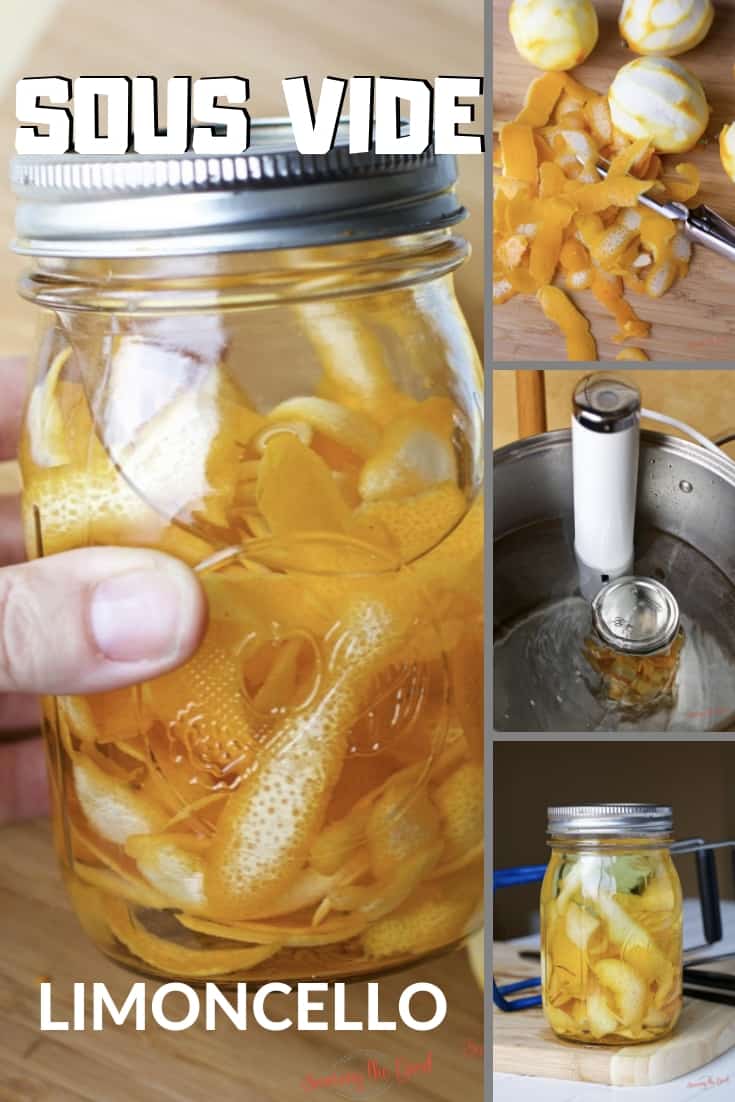
Sous vide limoncello is my take on the classic Italian lemon liqueur; bright, sweet, and full of fresh lemon zest infused into high-proof grain alcohol. I started making it the year I found two lonely bags of Meyer lemons at my Pennsylvania grocery store and did not want to wait weeks for them to steep. With about 15 minutes of prep and a 2-hour water bath, you can have homemade limoncello ready to bottle the same afternoon.

If you love bright lemon flavor, my silky sous vide lemon curd uses the same lemons, and you can find all of my water bath favorites in my sous vide recipes collection.
Why Make Limoncello with a Sous Vide
Classic limoncello sits in a jar for weeks while the zest slowly gives up its oils. Holding that jar at 135F speeds the whole thing up; warm alcohol pulls the lemon oils out of the peel much faster, and the temperature stays low enough that the zest never tastes cooked.
That makes this my go-to when I need homemade gifts in a hurry. Put your sous vide to work the same way it does for my homemade vanilla extract and holiday eggnog.
Limoncello Ingredients
Limoncello only has four ingredients, so each one has a job. Here is what each one does and why I chose it; the exact amounts are in the recipe card below.

Lemons
Meyer lemons are a cross between a lemon and a mandarin orange. Their zest is thinner, more floral, and a little sweeter than a regular grocery store lemon.
They are next to impossible to find in my part of Pennsylvania, so when they show up, I grab them. Regular lemons work too; I cover that in the substitutions below.
Buy unwaxed or organic lemons when you can. You are infusing the peel, so anything sitting on the outside of the lemon ends up in your bottle.
Grain Alcohol
High-proof grain alcohol is the traditional base for limoncello, and it does three things vodka does not. It pulls more oil out of the zest, it leaves room for plenty of syrup while still finishing around 30% alcohol, and it keeps the limoncello from freezing solid in your freezer.
I use 151-proof Everclear because it is sold in Pennsylvania state stores. The 190-proof version is not sold here or in about 15 other states, so check what your state carries before you shop.
Sugar and Water
The simple syrup sweetens the limoncello and brings the alcohol down to a sippable strength. The amount of syrup depends on the proof of your alcohol, so I put a quick chart in the recipe card notes.
Recipe Card?
To find the full printable recipe with specific measurements and directions CLICK HERE to go to the recipe card.
Substitutions
The spirit is the swap I get asked about most. The jar, the temperature, and the timing stay exactly the same; only the syrup changes.
190-proof Everclear. If your state sells it, use the same 2 cups with a larger batch of syrup (2 ½ cups sugar and 3 cups water), plus 1 or 2 extra lemons. It still finishes around 30% alcohol and makes about 6 cups.
80-proof vodka. This is the easiest to find, and it is how I first made this recipe. Cut the syrup to 1 cup sugar and 1 cup water; it finishes around 23% alcohol, so it tastes softer and lighter than a store-bought bottle, and it needs to live in the refrigerator because it can turn slushy in the freezer.
Regular lemons. Eureka or Lisbon lemons give you a sharper, more classic limoncello. Their peel is thicker, so go slow with the peeler to leave the white pith behind.
How to Make Sous Vide Limoncello
This is mostly hands-off; the only real work is peeling the lemons. Take your time with that step, because it decides how your limoncello tastes.
Preheat the water bath
Set your sous vide to 135F (57C) in a container deep enough for a quart jar. The water should come up to just below the lid once the jar goes in.

Scrub the lemons
Wash the lemons under hot water with a produce brush and dry them well. Hot water helps loosen any wax coating; wax keeps the oils locked in the peel.

Peel the zest
Use a vegetable peeler with light pressure to take off just the yellow outer layer in long strips. Flip a strip over; you want mostly yellow with only a thin haze of white. If you see thick white pith, scrape it off with a paring knife, because pith makes limoncello bitter.
Flip a strip over to check for pith; a thin haze of white is fine.

Fill the jar
Pack the zest into a quart canning jar and pour in the grain alcohol, leaving at least ½ inch of headspace. Screw on the lid and ring finger-tight only; the liquid expands as it warms, and a loose lid lets pressure escape instead of building up in the jar.

Sous vide for 2 hours
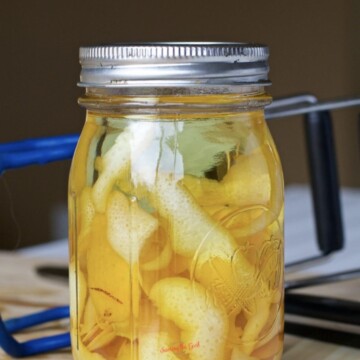
Lower the jar into the 135F water and let it go for 2 hours. By the end, the alcohol turns a clear, pale yellow and the zest looks noticeably paler.
Keep the water just below the lid, not over it.
Make the simple syrup
While the jar is in the bath, warm the sugar and water in a saucepan over medium heat, stirring until the sugar dissolves and the liquid turns completely clear. You do not need a rolling boil; boiling hard evaporates water and throws off your ratio. Let the syrup cool completely to room temperature.

Cool the jar before opening
Lift the jar out and set it on a towel until it reaches room temperature, about 1 hour. Open it away from the stove; warm high-proof alcohol gives off flammable vapor the second the lid comes off.
Strain
Pour the alcohol through a fine-mesh strainer to catch the zest. For a clearer limoncello, strain it a second time through a coffee filter.

Sweeten and chill
Stir the cooled syrup into the strained alcohol. Do not worry when it turns cloudy; that is the lemon oils coming out of the alcohol as it is diluted, and it is exactly what you want. Bottle it and chill it until it is ice cold.
No Sous Vide? Use the Traditional Method
You can make this same limoncello without a water bath; it just takes longer. Seal the zest and alcohol in the jar and let it sit in a cool, dark cupboard, about 1 to 2 weeks with Everclear or 3 to 4 weeks with 80-proof vodka, then strain and sweeten exactly as above.

Chef Tip: Handling High-Proof Alcohol Safely
- Grain alcohol at this strength is flammable, and warming it makes the vapor easier to ignite. Do your jar work away from gas burners, candles, or any open flame, and never heat the alcohol on the stovetop or in the microwave.
- Use a real canning jar, leave the headspace, and keep the lid finger-tight. Make sure your syrup is completely cool before you combine it with the alcohol.
- The infused alcohol is not ready to drink until the syrup is in. Label your bottles clearly and store them out of reach of kids.
Frequently Asked Questions
While I try to share all the information you need to make this recipe in your home with restaurant-quality results, there still may be a question or two. Or these are questions I have received from the community about this recipe. I do my best to answer them as clearly as I can. I hope this helps.
Why is my limoncello cloudy?
Cloudy limoncello is a good sign. The lemon oils dissolve in strong alcohol, and when you add the syrup, some of those oils come back out as tiny droplets that make it look milky.
Why does my limoncello taste bitter?
Bitterness almost always comes from the white pith. Next time, peel with lighter pressure and scrape off any thick white patches before the zest goes in the jar.
Should limoncello go in the freezer?
The Everclear version, yes; at around 30% alcohol it stays pourable and ice cold. The 80-proof vodka version belongs in the refrigerator because it can turn slushy in the freezer.

Ingredients
- 5 Meyer lemons scrubbed (zest only)
- 2 cups 151-proof grain alcohol such as Everclear (see notes for 190-proof or vodka)
- 2 cups Sugar
- 2 cups Water
Instructions
- Preheat a sous vide water bath to 135F (57C).
- Scrub the lemons under hot water and dry them.5 Meyer lemons
- Peel the yellow zest in strips with a vegetable peeler, leaving the white pith behind.
- Place the zest in a quart canning jar and add the grain alcohol, leaving ½ inch of headspace. Close the lid finger-tight.2 cups 151-proof grain alcohol
- Submerge the jar so the water reaches just below the lid. Cook 2 hours.
- Meanwhile, warm the sugar and water over medium heat, stirring until dissolved and clear. Cool completely.2 cups Sugar, 2 cups Water
- Remove the jar and cool to room temperature, about 1 hour, before opening. Open it away from any open flame.
- Strain through a fine-mesh strainer, then a coffee filter if you want it clearer.
- Stir in the cooled syrup, bottle, and chill until ice cold.
Nutrition
Notes
- Syrup by spirit (the jar and timing stay the same):
- 151-proof Everclear: 2 cups sugar + 2 cups water. About 30% alcohol, about 5 cups. Store in the freezer.
- 190-proof Everclear (not sold in all states): 2½ cups sugar + 3 cups water, plus 1 to 2 extra lemons. About 30% alcohol, about 6 cups. Store in the freezer.
- 80-proof vodka: 1 cup sugar + 1 cup water. About 23% alcohol, about 3½ cups. Store in the refrigerator, since it can turn slushy in the freezer.
- Storage: Keep sealed bottles in the freezer (Everclear version) or refrigerator (vodka version). Best within 1 year; the lemon flavor slowly fades after that.
- Make ahead: Make it at least a few days before gifting so the flavor has time to mellow. [Confirm the rest time after your test batch.]
- Safety: High-proof alcohol is flammable. Keep it away from open flames and never heat it on the stove or in the microwave.

I am Sarah Mock. Welcome!
Sarah Mock is a classically trained Chef and a graduate of Johnson & Wales University. A culinary blogger for 18 years, Sarah helps the home cook prepare her recipes with professional results.
as seen in:


originally published March 8, 2018


Cynthia Shepeck says
ooohhh, I'm new to sous vide, and will be trying this soon. Have you ever done a key lime version of this?
Brent says
Very awesome and useful content! Thank you for making the effort!
Shelby says
In lieu of a Sous Vide wand, couldn't this be accomplished with water in a crock pot set at low for 2 hours? I'll take the bullet & ask for those who are afraid to ask the stupid question- I know they're out there.