


How to carve a turkey breast comes down to one thing: following the bone, not fighting it. This is the knife skill I see trip up home cooks more than anything else once the bird comes out of the oven, and it is one of the first techniques taught in culinary school for exactly that reason. Get the angle right and the meat lifts off the carcass in two clean pieces. Rest the turkey 15 minutes, then plan on about 10 minutes to carve.

Before you get to this step, you have a few upstream decisions that make carving easier. Learn how to thaw a frozen turkey safely, then use my turkey brine recipe for a juicy roast turkey any time of year. Save the giblets bag for giblet gravy. If you want to skip the whole-bird carve entirely, my turkey roulade and sous vide turkey breast are both boneless from the start. This same knife technique works on the breast of a whole roasted turkey too; if you're carving the entire bird, start with how to carve a turkey and come back here once you're ready to separate and slice the breast.
How to Carve a Turkey Breast, Step by Step
Nine steps, one knife, and a little patience. I'll walk you through exactly where to cut and what to look for at each stage so you know you're doing it right. Before you carve, make sure the table's ready; here are side dishes that pair well with turkey.
Rest the turkey
Tent it loosely with foil and let it rest at least 15 minutes before you pick up a knife. This gives the juices time to redistribute back into the meat. Cut into it too soon and those juices end up on your cutting board instead of in your dinner.
Set up your carving station.
Large cutting board with a damp towel or non-slip mat under it (safety first!), sharp chef's knife, serving platter within reach. I use a chef's knife over a serrated one; if you're using a serrated one, use a quick sawing motion instead of long strokes.
Skip the electric knife here
In my experience, it shreds the meat more than it slices it, but if an electric knife is the only thing you know, I won't be there to stop you.
Locate the breastbone
Run your fingers down the center of the bird until you feel the ridge of the keel bone. That ridge is your guide for the entire cut; every slice you make traces its curve.
Cut along one side of the bone
Place your knife right against the bone and use long, even strokes to cut down through the meat, following the bone's curve all the way toward the plate. Keep the blade angled toward the bone, not away from it, or you'll leave meat behind.
Cut across the ribs
Bring your knife around to the front near the wishbone and cut down along the rib cage to connect with your first cut. This frees the entire side of the breast from the bone structure in one motion.
Pull the breast free
With the connecting cuts made, the meat should lift away from the carcass almost on its own. Use your hand to gently pull while your knife tip releases any spots that are still attached.
Trim any remaining connective tissue
A few stubborn bits usually stay behind. A short knife stroke separates them; you don't need to force anything.
Repeat on the other side
Same cuts, same order, mirror image.

Slice against the grain
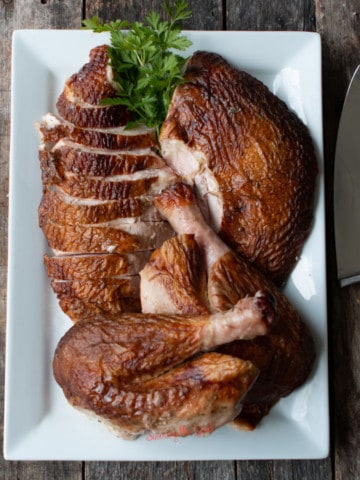
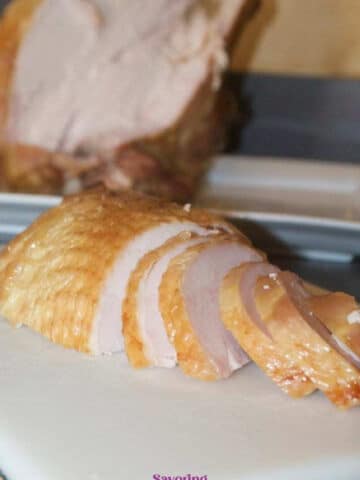
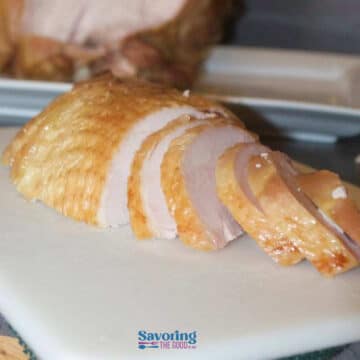
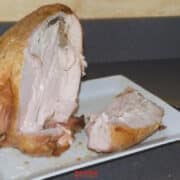
Turn the breast skin-side up and look for the direction the muscle fibers run. Slice perpendicular to those fibers, not parallel to them; this is what keeps each piece tender instead of stringy. Transfer slices to your platter as you go.
Leftover scraps and trim don't have to go to waste. Save the carcass and bones for homemade turkey stock, and put any extra meat toward Thanksgiving egg rolls or turkey poutine the next day.
Seasonal Favorite
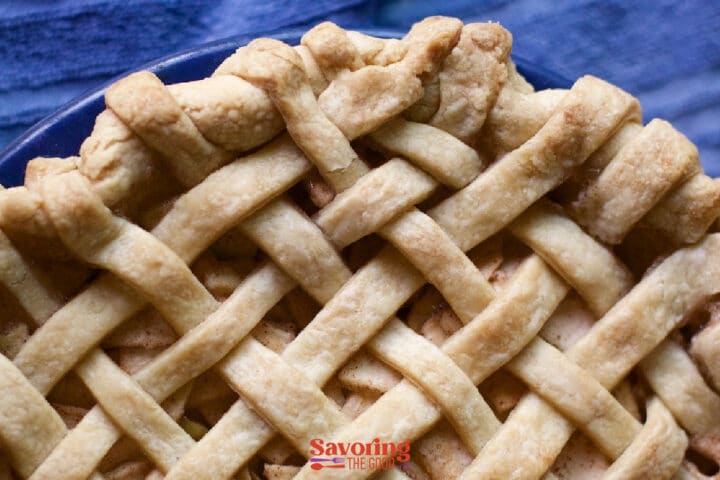
This is my award-winning Crisco pie crust recipe; flaky, tender, and made with simple ingredients you already have.




Sarah's Culinary Insight
Follow the bone, don't fight it. The breastbone runs the full length of the breast on a slight curve, and if your knife drifts off that curve even a little, you'll leave meat stuck to the carcass instead of on the platter.
A dull knife tears more than it cuts. If you find yourself sawing back and forth instead of slicing clean through, that's the knife's fault, not yours. Sharpen it before you carve, not after you've already shredded the skin.
Skip the rest and you lose the payoff. Fifteen minutes feels like a long wait when everyone's hungry at the table, but cutting in early is the single most common reason a carved turkey ends up dry on the plate.
Do you carve a turkey breast with the grain or against it?
Against the grain, always. Slicing against the grain cuts through the muscle fibers instead of alongside them, which is what keeps each slice tender. Slicing with the grain gives you long, stringy pieces that are harder to chew.
Which way does the grain run on a turkey breast?
The muscle fibers run lengthwise, from the neck end down toward the tail end of the breast. Look at the surface of the meat before you slice; you'll see faint parallel lines running that direction. Cut perpendicular to those lines.
How do you carve a turkey for beginners?
Start with the breast off the bone before you try slicing the whole bird tableside. Removing the breast in one piece, like the steps above, is far more forgiving than trying to carve around a whole turkey in front of guests. Once the breast is off, slicing it is straightforward.
How do you slice a single turkey breast?
The same technique applies whether you're working from a whole roasted turkey or a standalone bone-in turkey breast. Rest it, run your knife along the bone to remove the meat, then slice against the grain into portions.

Ingredients
- 1 Thanksgiving Turkey breast cooked
Instructions
- Rest the turkey 15 minutes, tented in foil.
- Set up a cutting board, sharp chef's knife, and serving platter.
- Cut along one side of the breastbone, following its curve down to the plate.

- Cut across the ribs near the wishbone to connect with your first cut.

- Pull the breast free, trimming any connective tissue that doesn't release on its own.
- Repeat on the other side.
- Slice against the grain and transfer to your platter.


Nutrition

I am Sarah Mock. Welcome!
Sarah Mock is a classically trained Chef and a graduate of Johnson & Wales University. A culinary blogger for 18 years, Sarah helps the home cook prepare her recipes with professional results.





Jimwhest says
Really interesting post!